#include <gSpriteAnimator.h>
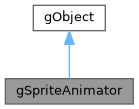
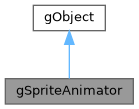
Public Member Functions | |
| gSpriteAnimator () | |
| virtual | ~gSpriteAnimator () |
| void | addAnimation (int animationId, gSpriteAnimation *animation) |
| void | changeAnimation (int animationId) |
| void | setFps (int animationId, int fps) |
| void | update () |
| void | draw (int x, int y) |
| void | draw (int x, int y, int w, int h) |
 Public Member Functions inherited from gObject Public Member Functions inherited from gObject | |
| gObject () | |
| void | logi (std::string message) |
| void | logd (std::string message) |
| void | logw (std::string message) |
| void | loge (std::string message) |
| void | logi (std::string tag, std::string message) |
| void | logd (std::string tag, std::string message) |
| void | logw (std::string tag, std::string message) |
| void | loge (std::string tag, std::string message) |
Additional Inherited Members | |
| Static Public Member Functions inherited from gObject | |
| static std::string | gGetAppDir () |
| static std::string | gGetAssetsDir () |
| static void | gSetAssetsDir (std::string assetsDir) |
| static std::string | gGetFilesDir () |
| static std::string | gGetImagesDir () |
| static std::string | gGetFontsDir () |
| static std::string | gGetModelsDir () |
| static std::string | gGetTexturesDir () |
| static std::string | gGetShadersDir () |
| static std::string | gGetSoundsDir () |
| static std::string | gGetDatabasesDir () |
| static std::string | gGetVideosDir () |
| static void | setCurrentResolution (int scalingNo, int currentResolutionNo) |
| Static Public Attributes inherited from gObject | |
| static const int | LOGLEVEL_SILENT |
| static const int | LOGLEVEL_DEBUG |
| static const int | LOGLEVEL_INFO |
| static const int | LOGLEVEL_WARNING |
| static const int | LOGLEVEL_ERROR |
| Static Protected Attributes inherited from gObject | |
| static int | renderpassnum |
| static int | renderpassno |
| static int | releasescaling |
| static int | releaseresolution |
Detailed Description
An instance of this class should be created for each object that is to be animated inside the game. For example; if the developer has a character, an enemy and a door, three instances of this class should be created. Then, the object's individual animations should be added to this class by calling addAnimation.
Constructor & Destructor Documentation
◆ gSpriteAnimator()
| gSpriteAnimator::gSpriteAnimator | ( | ) |
◆ ~gSpriteAnimator()
|
virtual |
Member Function Documentation
◆ addAnimation()
| void gSpriteAnimator::addAnimation | ( | int | animationId, |
| gSpriteAnimation * | animation | ||
| ) |
The first argument is just an arbitrary number that is used assigned to the animation passed as the second argument. It can be used with the changeAnimation function to change into playing another animation.
Second argument should always be created with createSpriteAnim function.
- Parameters
-
animationId The id that will be given to the animation that's being passed in. animation The animation object
◆ changeAnimation()
| void gSpriteAnimator::changeAnimation | ( | int | animationId | ) |
Changes the current playing animation to the specified animation. The animationId should be the id that was assigned to the gSpriteAnimation object passed in when calling addAnimation.
- Parameters
-
animationId The animation id that was assigned to the gSpriteAnimation object.
◆ draw() [1/2]
| void gSpriteAnimator::draw | ( | int | x, |
| int | y | ||
| ) |
The two parameter draw function.
Call this function inside the draw function of the related Canvas. This draws the current animation on to the x and y coordinates of the screen.
- Parameters
-
x The x coordinate for the sprite. y The y coordinate for the sprite.
◆ draw() [2/2]
| void gSpriteAnimator::draw | ( | int | x, |
| int | y, | ||
| int | w, | ||
| int | h | ||
| ) |
The two parameter draw function.
Call this function inside the draw function of the related Canvas. This draws the current animation on to the x and y coordinates of the screen and scales it by w and h.
- Parameters
-
x The x coordinate for the sprite. y The y coordinate for the sprite. w The scaling on the x axis. h The scaling on the h axis.
◆ setFps()
| void gSpriteAnimator::setFps | ( | int | animationId, |
| int | fps | ||
| ) |
Sets the fps of the given animation.
- Parameters
-
animationId The animation id that was assigned to the gSpriteAnimation object.
◆ update()
| void gSpriteAnimator::update | ( | ) |
Call this update inside the related Canvas's update function.
The documentation for this class was generated from the following file: